 |
 |
 |
 |
 |
 |
 |
 |
 |

 |
Shenzhou 6 Safely Returns Taikonauts
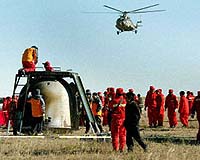
China's second manned space mission returned safely to Earth early Monday after a successful five-day flight, in the latest chapter in China's ambitious drive to become a global space power. Astronauts Fei Junlong and Nie Haisheng were given a clean bill of health after the reentry capsule of their Shenzhou VI spacecraft glided to Earth on a parachute, ending up in Inner Mongolia, Xinhua news agency said. Emerging from the module, television pictures showed the two take a few seconds to adjust to the Earth's gravity, before being presented with bouquets of flowers and waving to assembled recovery teams and ground control staff. Mission control declared the mission a success, Xinhua said. A helicopter pilot from one of the recovery teams reported that the capsule landed upright after touching down at 4:32 am (2032 GMT), just one kilometre (1,100 yards) from the intended landing site, it added. The Beijing News earlier reported that a welcoming ceremony was scheduled for between 6:30 and 7:30 am (2230 and 2330 GMT Sunday) at a military air base in the area. The flight was China's second-ever manned space mission following the historic Shenzhou V, which in October 2003 made China the third nation after the former Soviet Union and the United States to put a man into space. Shenzhou VI had been carrying enough food, water and oxygen for a seven-day mission, although planners had expected it to spend just five days in orbit. The spacecraft blasted off from the Jiuquan Satellite Launch Center on Inner Mongolia's border with Gansu province on Wednesday. During his 21-hour maiden flight in 2003, lone astronaut Yang Liwei never left his seat in the re-entry capsule nor take off his space suit. In contrast, Fei and Nie's flight saw them leave the re-entry capsule and enter the orbital capsule, shedding their bulky suits and donning ordinary work clothes so they could move around easily. During their time in space, the astronauts successfully fired rockets to adjust the craft's altitude, ensuring it remained in its pre-planned orbit -- which was crucial for its return to Earth, a mission control spokesman said. Premier Wen Jiabao hailed the historic second mission as a success after watching from the launch pad on Wednesday. The launch captivated the nation, with millions of Chinese watching it on television. Dispelling concerns that China could use space for military purposes, Wen said the purpose of the mission was to conduct experiments "entirely for peaceful purposes." The Chinese government also hopes to use the manned space program to invigorate patriotism and instil a curiosity in science and technology amongst China's largely agrarian population. China's state press gushed over the mission, with the leading People's Daily saying its success embodied "China's special character," its technical progress, national strength and international competitiveness. The craft is based on the robust and thoroughly tested Soviet design for the Soyuz vessel, and consists of three modules. These include the orbital module where scientific experiments are carried out; the re-entry capsule where the astronauts spend most of their time and the service module, which contains fuel and air, solar panels and other technical gear. "This is the first time for Shenzhou spacecraft to apply the whole system, and the successful flight this time would indicate that China's technology in Shenzhou spacecraft is close to be mature," Zhang Bainan, chief designer of the spacecraft system, told Xinhua earlier. Spending on the Shenzhou series of launches has reached roughly 19 billion yuan (2.3 billion US dollars), less than 10 percent of the US annual spending on space programs, Xinhua quoted a space science researcher with the Chinese Academy of Sciences saying last week.
related report The craft would land early in the morning "as scheduled", the Xinhua news agency said Sunday. Earlier in the day, Chinese authorities said that weather conditions were looking good for the safe return of the spacecraft. Yang Guiming, a senior engineer at the China Central Meteorological Station, said weather conditions were expected to be "pretty good" on Monday and Tuesday in the Siziwang region in Inner Mongolia where the craft is expected to land. He said visibility was expected to be good, the wind steady and no rain was forecast. The website of the People's Daily, the mouthpiece of the ruling Communist Party, said space officials were meeting Sunday to plan the re-entry of the vessel, China's second manned space flight. State media have said the Shenzhou VI was scheduled to land in the grasslands of Inner Mongolia early Monday after five days in space, although the exact timing of the return could be subject to last-minute adjustment because of the weather. A welcoming ceremony is tentatively scheduled for sometime between 6:30 and 7:30 am Monday (2230 and 2330 GMT Sunday) at a military air base in Inner Mongolia, the Beijing News reported. At the landing site in Siziwang, a public notice has been distributed, warning potential onlookers to stay away. Shenzhou VI is carrying enough food, water and oxygen for a seven-day mission although planners had expected a five-day journey. The space craft blasted off from the Jiuquan Satellite Launch Center on Inner Mongolia's border with Gansu province on Wednesday. The flight is China's second-ever manned space mission following the historic Shenzhou V, which in October 2003 made China the third nation after the former Soviet Union and the United States to put a man into space. Astronauts Fei Junlong and Nie Haisheng sent greetings late Sunday to the Chinese people, Xinhua said. "We're grateful for the deep love and concern by all Chinese people, the Hong Kong, Macau and Taiwan compatriots," Nie said in the brief satellite hook-up, according to Xinhua. Fei pledged to "do our utmost to fulfill the mission", adding that the pair were "feeling good".
related report Hu arrived at the Beijing Aerospace Command and Control Center for a two-minute conversation transmitted live on TV and radio beginning from 4:29 pm (0829 GMT). "The motherland and the people are proud of you," Hu told the two men in orbit as he stood up amid rows of space program workers in blue uniforms. "I hope you will successfully complete your task by carrying out the mission calmly and carefully and have a triumphant return," he said. Fei Junlong, one of the astronauts, thanked Hu and the Chinese people for their support, saying: "We'll definitely fulfill our mission." The dialogue took place just a few hours after spacecraft Shenzhou VI, embarked on China's most ambitious foray into space yet, entered its fourth day of orbiting the Earth. Shenzhou VI is scheduled to land in the grasslands of Inner Mongolia early Monday after five days in space, although the exact timing of the return could be subject to last-minute adjustment due to the weather, state media has said. A welcoming ceremony is tentatively scheduled for sometime between 6:30 and 7:30 am Monday (2230 and 2330 GMT Sunday) at a military air base in Inner Mongolia, the Beijing News reported. At the landing site in Siziwang county, a public notice has been distributed, warning all potential curious onlookers to stay away. "Apart from ground crew involved in the return of the spacecraft, no one else is allowed to go to the landing site to watch," the Beijing News cited the notice as saying. Herdsmen in the area have also been told not to house any outsiders in the coming days, possibly in an attempt to avoid an influx of space enthusiasts. A more accommodating attitude was adopted Wednesday when Shenzhou VI blasted off from the Jiuquan Satellite Launch Center on Inner Mongolia's border with Gansu province. Large tour groups were allowed to within just a few kilometers of the launch site. The stricter measures for Monday were justified with the need to ensure the astronauts' safety, according to the Beijing News. The flight is China's second-ever manned space mission following the historic Shenzhou V, which in October 2003 made China the third nation after the former Soviet Union and the United States to put a man into space. Meanwhile, state media said Saturday that China may choose its southern island province of Hainan as the site of a new launch pad for a new generation of carrier rockets. The Xinhua news agency cited Liu Zhusheng, chief designer of China's carrier rocket system, as saying rockets launched from the site will have a launch capacity of up to 25 tonnes. That would make them suitable for launching a space station, one of China's ambitions for the coming years. Hainan had earlier been mulled as the site of a launch pad, with scientists going on record as early as 1999 saying it would be a favorable location.
related report The spacecraft, which is orbiting the Earth, may land on the grasslands in the Inner Mongolia Autonomous Region about 6am Saturday, the newspaper said, citing an unnamed source. There is no official announcement about its return time. But official TV anchormen and anchorwomen did not use "five-day space mission" Thursday as often as Wednesday during the live broadcast periods. Shenzhou VI is officially scheduled to come back Sunday, five days after its blastoff on Wednesday morning. Meanwhile, a newspaper in Lanzhou City, Gansu Province, Wednesday also said the space voyage could shrink to three days from planned nearly five days. "Experts" were quoted by the newspaper that weather conditions of the landing area and physical conditions of the astronauts will result in a change of original schedule.
Related Links |
|
|