 |
 |
 |
 |
 |
 |
 |
 |
 |

 |
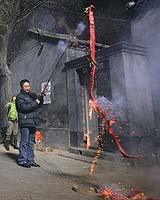
China's Lunar Fireworks Frenzy Kills 36
Beijing, Jan 30 (AFP) Jan 30, 2006 Fireworks explosions killed 36 people and injured hundreds more in China as traditional Lunar New Year celebrations led to much mayhem as well as joy across the nation, officials and state media said Monday. In the most serious accident, 36 people at a temple fair in the central province of Henan were killed on New Year's Day Sunday when a nearby store room full of fireworks exploded, Xinhua news agency said. The accident, in a mountainous area of Anyang city, injured up to 48 other people, it said, quoting sources with the local government. Sixteen were initially reported to have been killed but the death toll rose after another more bodies were discovered during clear up operations and some victims died of their injuries, the news agency said. In the capital Beijing, where a 12-year ban on Lunar New Year fireworks had just been lifted, the government reported 112 people were treated at hospital emergency rooms over the weekend for fireworks-related injuries. Seventeen people suffered serious eye injuries, the State Administration of Work Safety said in a statement. Another 26 were admitted to hospitals with various types of other wounds, it said. More than 60 people were treated at Beijing's Tongren Hospital, which is the city's number one medical facility for eye care, the Beijing News reported. "On New Year's Eve alone, we had more than 40 injuries and among them there were around a dozen people with serious injuries," the paper quoted hospital assistant director Tian Jian as saying. In China's southwestern Chongqing city, where the fireworks ban was also lifted after 12 years, firefighters rushed to extinguish nearly 200 fires caused by fireworks on New Year's Eve, the Xinhua news agency reported. "There were 191 fires caused by fireworks overnight on New Year's Eve ... a record for the city," Xinhua quoted a local fireworks official as saying. "Around 3,000 firefighters gave up the chance to spend the New Year with their families to remain on duty the whole time ... they have been under enormous pressure." However, Chongqing officials said there had been no reports of injuries. A ban on fireworks, which are traditionally believed to ward off evil spirits and ghosts trying to enter the new year, was put in place across 200 cities in China in 1994 due to safety and environmental pollution concerns. The ban was lifted last year for more than 100 cities after authorities said the industry had been cleaned up to ensure higher safety standards. The ban was lifted in Beijing and many other cities this year. In Beijing, a city of 15 million people, the sounds of huge explosions have for days thundered through the alleyways of traditional courtyard districts as well as the modern areas of new condominiums and office high-rises. The city's streets have been left littered with used fireworks, with the Beijing Environmental Protection Bureau reporting 458 tonnes of such waste collected on New Year's Day alone, according to the Beijing News Daily. However, amid the fireworks mayhem, state press reported China's 1.3 billion people were largely enjoying the festivities, with celebrations to continue throughout all of this week's worth of public holidays. Tens of thousands of people flocked to temples in Beijing -- once closed as symbols of feudal superstition by the Communist regime -- on Sunday and Monday.
Source: Agence France-Presse Related Links -  Taiwan Leader Considers Dropping Reunification Unit
 Taipei, Jan 29 (AFP) Jan 29, 2006
Taiwan's President Chen Shui-bian said Sunday he would "seriously consider" abolishing a council and guidelines on the island's eventual reunification with China. |
|
|

| The content herein, unless otherwise known to be public domain, are Copyright 1995-2006 - SpaceDaily.AFP and UPI Wire Stories are copyright Agence France-Presse and United Press International. ESA PortalReports are copyright European Space Agency. All NASA sourced material is public domain. Additionalcopyrights may apply in whole or part to other bona fide parties. Advertising does not imply endorsement,agreement or approval of any opinions, statements or information provided by SpaceDaily on any Web page published or hosted by SpaceDaily. Privacy Statement |