|
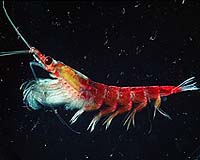
Krill Discovered Living In The Antarctic Abyss
London, UK (SPX) Feb 26, 2008 Scientists have discovered Antarctic krill (Euphausia superba) living and feeding down to depths of 3000 metres in the waters around the Antarctic Peninsula. Until now this shrimp-like crustacean was thought to live only in the upper ocean. The discovery completely changes scientists' understanding of the major food source for fish, squid, penguins, seals and whales. Reporting this week in the journal Current Biology, scientists from British Antarctic Survey (BAS) and the National Oceanography Centre, Southampton (NOCS) describe how they used a deep-diving, remotely operated vehicle (RoV ) known as the Isis to film previously unknown behaviour of krill. Professor Andrew Clarke of the British Antarctic Survey said, "While most krill make their living in the ocean's surface waters, the new findings revise significantly our understanding of the depth distribution and ecology of Antarctic krill. It was a surprise to observe actively-feeding adult krill, including females that were apparently ready to spawn, close to the seabed in deep water." Scientists have been studying krill since the 'Discovery' expeditions of the early 20th century. Oceanographic expeditions, using a combination of echo-sound techniques and collection samples in nets, indicated that the bulk of the population of adult krill is typically confined to the top 150 metres of the water column. The grant to purchase the Isis RoV was led by Professor Paul A Tyler of NOCS. He says, "Having the ability to use a deep-water ROV in Antarctica gave us a unique opportunity to observe the krill and also to observe the diversity of animals living at the deep-sea floor from depths of 500m down to 3500m. The importance of such observations is that, not only do we have the ability to identify species, but we can see the relations among individual species and their relationship to the ambient environment." The discovery holds some important lessons, Clarke continued. "The behaviour of marine organisms - even quite 'primitive' ones - can be complex and more varied than we usually assume. There is still a great deal to learn about the deep sea and an important role for exploration in our attempts to understand the world we live in." Community Email This Article Comment On This Article Related Links British Antarctic Survey Beyond the Ice Age
 Antarctic census set to reveal new species: scientists
 Sydney (AFP) Feb 20, 2008
An international project to document the sea life of Antarctica is likely to reveal new species among the dinner-plate sized sea spiders and other overgrown animals of the deep, scientists said Wednesday. |
|
|

| The content herein, unless otherwise known to be public domain, are Copyright 1995-2007 - SpaceDaily.AFP and UPI Wire Stories are copyright Agence France-Presse and United Press International. ESA Portal Reports are copyright European Space Agency. All NASA sourced material is public domain. Additional copyrights may apply in whole or part to other bona fide parties. Advertising does not imply endorsement,agreement or approval of any opinions, statements or information provided by SpaceDaily on any Web page published or hosted by SpaceDaily. Privacy Statement |