 |
 |
 |
 |
 |
 |
 |
 |
 |

 |
NASA Aims To Clear Up Mystery Of Elusive Clouds At Edge Of Space
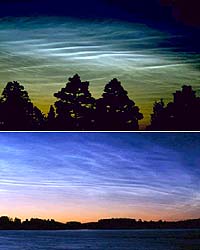
Hampton VA (SPX) Apr 12, 2007 NASA is preparing to launch the Aeronomy of Ice in the Mesosphere (AIM) spacecraft, the first mission dedicated to exploration of mysterious ice clouds that dot the edge of space in Earth's polar regions. These clouds have grown brighter and more prevalent in recent years and some scientists suggest that changes in these clouds may be the result of climate change. The first opportunity for launch is on Wednesday, April 25 from Vandenberg Air Force Base, Calif., aboard a Pegasus launch vehicle. AIM will conduct the first detailed probe of this unusual phenomenon typically observed approximately 50 miles above the Earth's surface in the mesosphere. The mesosphere is the region just above the stratosphere. Researchers know very little about how these polar mesospheric clouds form, why they are being seen at lower latitudes than ever before or why they have recently grown brighter and more frequent. "These clouds are indicators of conditions in the upper reaches of the Earth's atmosphere, and are an important link in the chain of processes that result in the deposition of solar energy into Earth's atmosphere," said Mary Mellott, AIM program scientist, NASA Headquarters, Washington. "AIM will provide an understanding of how and why these clouds form, an important contribution toward the NASA goals of understanding the fundamental physical processes of our space environment and how the habitability of planets is affected by the interaction of planetary magnetic fields and atmospheres with solar variability." The clouds are noctilucent, meaning they can be seen from the ground only at night, when they are illuminated by sunlight no longer visible from the Earth's surface. The brightest of these clouds are now known to be primarily composed of water ice. Their seasonal lifecycle is controlled by complex interactions between temperature, water vapor, solar activity, atmospheric chemistry and small particles on which the cloud crystals form. Human-induced factors such as carbon dioxide cause a warming in the lower atmosphere but a cooling in the mesosphere. The clouds form in the coldest part of the Earth's atmosphere at the summer season in the polar regions. In the northern hemisphere they begin appearing in mid-May and last through mid-August, in the southern hemisphere beginning mid-November and lasting through mid-March. "The occurrence of these clouds at the edge of space and what causes them to vary is not understood," said AIM principal investigator James Russell III, Hampton University, Hampton, Va. "One theory is that the cloud particles grow on 'seeds' of meteoric dust or dust lofted up from below. AIM will provide the comprehensive data needed to test current theories for cloud formation or develop new ones, and allow researchers to build tools to predict how they will change in the future." AIM will be comprised of three instruments: the Solar Occultation for Ice Experiment; the Cloud Imaging and Particle Size Experiment; and the Cosmic Dust Experiment. The satellite will simultaneously measure air pressure and temperature, moisture content and cloud dimensions, providing data needed to determine the role of polar mesospheric clouds as an important indicator of the planet's changing climate. The clouds appear to be a relatively recent phenomenon, first reported in the late 19th century shortly after the volcanic eruption on the Indonesian island of Krakatoa. The first daytime observations of the clouds were made by satellite in 1969. Regular space-based observations began in 1982 with NASA's Solar Mesosphere Explorer using instruments primarily designed for other purposes. "This Small Explorer mission is a good example of the huge science returns we can get for a relatively small cost investment," said Vicki Elsbernd, program executive for the AIM mission, NASA Headquarters. Email This Article
Related Links  Boulder CO (SPX) Apr 11, 2007
A satellite carrying two University of Colorado at Boulder instruments to study silvery-blue clouds that mysteriously form 50 miles above Earth's polar regions every year is slated to launch from Vandenberg Air Force Base in California on April 25. |
|
|

| The content herein, unless otherwise known to be public domain, are Copyright 1995-2006 - SpaceDaily.AFP and UPI Wire Stories are copyright Agence France-Presse and United Press International. ESA PortalReports are copyright European Space Agency. All NASA sourced material is public domain. Additionalcopyrights may apply in whole or part to other bona fide parties. Advertising does not imply endorsement,agreement or approval of any opinions, statements or information provided by SpaceDaily on any Web page published or hosted by SpaceDaily. Privacy Statement |