 |
 |
 |
 |
 |
 |
 |
 |
 |

 |
Taiwan's Chen Turns On China To Win Friends At Home
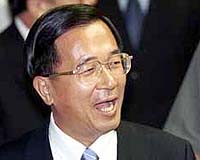
Taipei (AFP) Jan 31, 2006 With his popularity rating at an all time low, Taiwanese President Chen Shui-bian is trying to revive his fortunes by taking a tougher line with China, which has alarmed the United States, analysts say. Chen has vowed to "seriously consider" abolishing guidelines on reunification with China, and suggested reapplying to join the United Nations in the name of Taiwan and putting a new consitution to a new referendum. This week's comments by the president, who favours independence for the island off the southeastern Chinese coast, are bound to anger Beijing, and have already caused consternation in Washington. In a rare move, the US State Department issued a statement defining US policy towards Taiwan, emphasizing that Washington "does not support Taiwan's independence and opposes unilateral changes to the status quo". China considers Taiwan part of its territory even though the island has been ruled as a de facto independent state since 1949. It threatens to invade if Taipei declares formal independence. If Chen carried through on his comments, he would be defying pledges he made in 2000 and again in 2004 not to seek formal independence. Analysts said they did not believe Chen had changed course, but that he was playing the China card to revive his own fortunes following the poor showing of his Democratic Progressive Party (DPP) in December polls. "Chen is trying to solidify his support base by fanning anti-China sentiment as he has done before," said George Tsai, a political analyst at National Chengchi University. However Tsai said Chen was unlikely to carry through on his statements, mainly because of pressure from the United States, which is Taiwan's leading arms supplier, despite formally switching diplomatic recognition from Taipei to Beijing in 1979. "Ideally Chen would like to go down the road to independence, but he is unlikey to do so," Tsai said. Professor Chang Ya-chung, from the National Taiwan University, agreed Chen was grand-standing for the domestic audience. "Chen was attempting to demonstrate his clout on national policy to prove he can still have influence," said Chang, adding that the Taiwanese leader was also frustrated over the stalemate in relations with China. "Chen feels that he can't achieve a breakthrough in cross-strait ties, so he might as well stress Taiwan's separate identity to court those who support Taiwan's independence," Chang said. One of the key proposals Chen revealed Sunday was abolishing the National Unification Council, set up in 1990 and once the island's top policy-making forum on the key question of unification. Chen said during his inauguration in 2000 that he would uphold the council and the guidelines in one of his promises not to seek formal independence. He reiterated the promise after his 2004 poll victory. But halfway through his second four-year term, Chen began 2006 on a confrontational note, laying out the need for Taiwan to have a bigger arms budget and a new constitution. Tung Cheng-yuan, a professor at National Chengchi University and a former advisor to the ruling DPP, said Chen was frustrated with China. "In the past six years since Chen took office, China has showed no signs of goodwill," said Tung. However he said Chen's suggestion to scrap the guidelines and the council were mainly symbolic and would not affect policy. A US State Department official, speaking on condition of anonymity, told reporters in Washington that Chen had "said some stuff that is going to spin people up." He said Washington had decided to release its statement on Taiwan in an attempt to calm public opinion in both Taiwan and mainland China. "We thought it would be useful to make it clear in a public way that the goal posts haven't changed on this," the official said. Taiwan opposition leader Ma Ying-jeou warned the president he was straying into dangerous territory. "His move would impact cross-strait ties and relations with the United States. I called on him to be careful on this issue," he said
Source: Agence France-Presse Related Links -  US Astonished By Taiwan Leader's Hardline Policies On China
 Washington (AFP) Jan 31, 2006
The United States said Monday it was astonished by Taiwanese President Chen Shui-bian's planned hardline policies on China, warning they could send the wrong signals to Beijing. |
|
|

| The content herein, unless otherwise known to be public domain, are Copyright 1995-2006 - SpaceDaily.AFP and UPI Wire Stories are copyright Agence France-Presse and United Press International. ESA PortalReports are copyright European Space Agency. All NASA sourced material is public domain. Additionalcopyrights may apply in whole or part to other bona fide parties. Advertising does not imply endorsement,agreement or approval of any opinions, statements or information provided by SpaceDaily on any Web page published or hosted by SpaceDaily. Privacy Statement |