 |
 |
 |
 |
 |
 |
 |
 |
 |

 |
US Astonished By Taiwan Leader's Hardline Policies On China
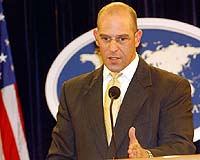
Washington (AFP) Jan 31, 2006 The United States said Monday it was astonished by Taiwanese President Chen Shui-bian's planned hardline policies on China, warning they could send the wrong signals to Beijing. The independence-leaning Chen said Sunday he would "seriously consider" abolishing guidelines on reunification with China, and the body that created them, in a move that could anger Taiwan's giant neighbour. He also reportedly wanted Taipei to consider applying to rejoin the United Nations in the name of Taiwan, and draft a new constitution, and put it to a referendum next year. China considers Taiwan part of its territory even though the island has been ruled as a de facto independent state since the end of a civil war in 1949. It threatens to invade if Taipei declares formal independence. In a rare move, the US State Department issued a statement Monday defining US policy towards Taiwan, emphasizing that Washington "does not support Taiwan's independence and opposes unilateral changes to the status quo by either Taiwan or Beijing." The United States, which is obliged by law to offer Taiwan a means of self-defense if its security is threatened, is the leading arms supplier to the island despite switching diplomatic recognition from Taipei to Beijing in 1979. "We're issuing this in the wake of some comments by President Chen in Taiwan, that we don't want to be inflammatory or send the wrong signal, so we thought it useful to reiterate US policy on the subject," said Adam Ereli, the deputy State Department spokesman, alerting reporters of the statement at the beginning of the department's daily briefing on Monday. A US State Department official, speaking on condition of anonymity, told reporters that Chen had "said some stuff that is going to spin people up. "We don't want people to get spun up. We don't want China to get spun up, we don't want Taiwan to get spun up. So we thought it would be useful to make it clear in a public way that the goal post haven't changed on this," the official said. Asked to identify aspects of Chen's statement that could send the wrong signals, the official said, "Like Taiwan wanting a seat at the UN, change in constitution ... things that he said he wouldn't say again and now he said it again." "It's like woah, woah, woah...," said the official, sounding that Chen was pushing things too far. One of the key proposals Chen revealed Sunday was abolishing the National Unification Council, set up in 1990 and once the island's top policy-making forum on the key question of unification. The move could fuel Beijing's suspicions that he is pushing for independence. Chen had said during his inauguration in 2000 that he would uphold the council and the guidelines in one of his promises not to seek formal independence for the island. He reiterated that promise in 2004 after he was narrowly reelected for a second and final term. Halfway through his second four-year term, Chen began 2006 on a confrontational note, underlying the need for Taiwan to have a bigger arms budget and a new constitution. Ereli said that the United States' "unofficial relationship" with Taiwan was governed by its "one China" policy and added that "we have made no changes" to it. The United States urges both Beijing and Taipei to establish substantive dialogue and supports expansion of transportation and communication links across the Strait, he said. "We support expansion of transportation and communication links across the Strait aimed at increasing political, economic, social, and cultural exchanges with a view to increasing mutual understanding and diminishing the chances of miscommunication or misunderstanding," he said.
Source: Agence France-Presse Related Links -  Taiwan's Chen Turns On China To Win Friends At Home
 Taipei (AFP) Jan 31, 2006
With his popularity rating at an all time low, Taiwanese President Chen Shui-bian is trying to revive his fortunes by taking a tougher line with China which has alarmed the United States, analysts say. |
|
|

| The content herein, unless otherwise known to be public domain, are Copyright 1995-2006 - SpaceDaily.AFP and UPI Wire Stories are copyright Agence France-Presse and United Press International. ESA PortalReports are copyright European Space Agency. All NASA sourced material is public domain. Additionalcopyrights may apply in whole or part to other bona fide parties. Advertising does not imply endorsement,agreement or approval of any opinions, statements or information provided by SpaceDaily on any Web page published or hosted by SpaceDaily. Privacy Statement |